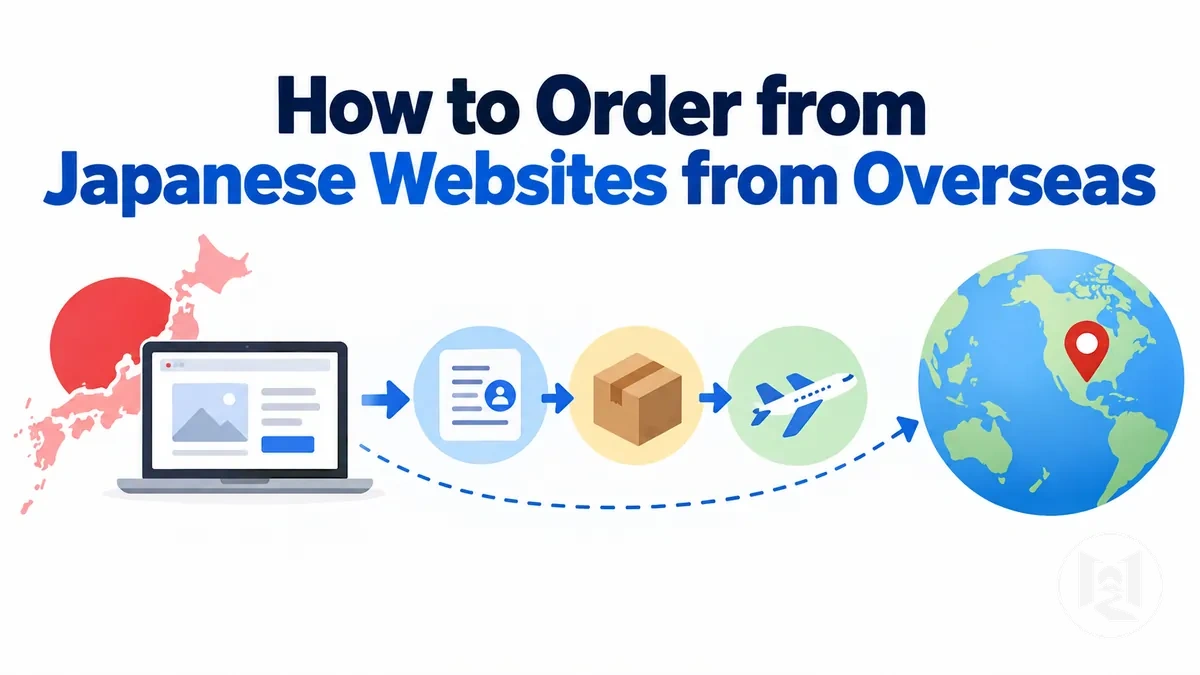
To order from a Japanese website overseas, first confirm that the store and the specific item can serve your destination, then use the route the retailer supports: direct international shipping, a Japanese forwarding address, or a proxy/intermediary service. Prepare an address and payment method accepted for that route, submit the order, and treat retailer acceptance as separate from payment authorisation or an automated order receipt. The order is not yet in international shipping until the required domestic handoff, if any, and the relevant shipping transition are confirmed.
Choose the route that fits this order
The workable route depends on what the retailer accepts for this item, destination, address and payment context. Use the route conditions below before attempting checkout.
Direct international shipping
Use when
The retailer ships the specific item to your destination and accepts your checkout details.
Who places the order
You place the order directly with the Japanese retailer.
Checkout address
Your supported overseas delivery address.
Japan-side handoff
Usually none beyond the retailer's normal fulfilment and carrier handoff.
Japanese forwarding address
Use when
You can place and pay for the order, but the retailer requires delivery to a Japanese address before overseas forwarding.
Who places the order
You place the retailer order; the forwarding service receives and re-ships the parcel.
Checkout address
The Japanese warehouse or member address supplied by the forwarding service.
Japan-side handoff
Retailer → forwarding service → international carrier.
Proxy purchasing service
Use when
You need a Japan-based service to purchase on your behalf, subject to that service's retailer and item rules.
Who places the order
The proxy purchases from the retailer for you.
Checkout address
The proxy handles the retailer-side delivery; you provide the overseas delivery details required by the proxy.
Japan-side handoff
Retailer → proxy service → international carrier.
Four gates every route must clear
Eligibility: the retailer, item and destination must be compatible with the route.
Checkout fit: the required address, payment and shipping-option details must be accepted.
Order acceptance: a submitted order must progress beyond a receipt or payment state into retailer acceptance.
Shipping transition: any required Japan-side handoff must complete before international movement can be verified.
A forwarding or proxy service can change the ordering path, but it does not make a restricted item or unsupported destination automatically eligible. Service availability, fees and shipment restrictions still need to be checked for the specific order.
Start with the pre-order checks below. If the order stops, diagnose the exact stage—eligibility, checkout, acceptance or handoff—rather than treating every failure as an international-shipping problem.
Table of Contents⌄
What You Need Before Ordering from a Japanese Website
Before ordering from a Japanese website, confirm the prerequisites that could prevent the order from proceeding to checkout: destination eligibility, item eligibility, an available ordering route, and checkout-ready address details and payment method.
These requirement categories show whether the order can be attempted and whether the buyer is prepared to proceed, while the exact conditions remain retailer- and order-dependent.
An order is ready to attempt only when the destination and item are eligible, a workable ordering route exists, and the address and payment details fit that route. Before submitting, compare the route-dependent total cost rather than the item price alone.
Confirm the Store and Item Can Serve Your Destination
Before checkout, confirm both store-level destination support and item-level eligibility for the same destination.
A Japanese retailer may support international shipping to a country while a particular item or product category remains ineligible, so the two checks must be evaluated separately.
Retailer support: the destination must fall within a delivery region the Japanese retailer serves for the order to remain eligible.
Item eligibility: the specific item must be available for shipment to that destination rather than subject to an item restriction.
Delivery region: the order address must fall within the retailer's supported region for the available international shipping route.
Product category: if the retailer applies category-specific shipping conditions, the item's category must remain eligible for the destination.
Retailer-level destination support and item-level eligibility can produce different results for the same country: a store may serve the destination while a particular product or category remains excluded. If either eligibility check fails, do not proceed on that route; if both pass, continue to route selection.
Identify the Ordering Route Available for the Purchase
The ordering route is determined by the retailer, item, destination and checkout constraints. The three common patterns are direct international shipping, a Japanese forwarding address, and a proxy purchasing service.
The route determines who places the purchase, which address is used at retailer checkout, and whether a Japan-side handoff is required before international shipping.
Direct international shipping: Use this when the retailer ships the specific item to your supported overseas destination and accepts your checkout details; the retailer order uses your overseas delivery address and no forwarding warehouse is required.
Japanese forwarding address: Use this when you can place and pay for the retailer order but delivery must first go to a Japanese address; you use the address supplied by the forwarding service, which receives the parcel and arranges the later overseas shipment.
Proxy purchasing service: Use this when a Japan-based service needs to buy on your behalf; the proxy handles the retailer-side purchase and receipt, then the parcel proceeds through the proxy's international-shipping process subject to its rules.
The route is an operational fit, not a ranking of which method is universally best. Choose the simplest route that the retailer, item, destination, address and payment conditions actually support.
Prepare Address and Payment Details Accepted at Checkout
Before submitting an order, make sure the delivery address, billing details and payment method match the selected route and the retailer's checkout conditions.
Address readiness and payment readiness are separate checks, and successful checkout validation of entered fields does not by itself mean the retailer has accepted the order.
Shipping address: enter the delivery address in the format and destination configuration accepted by the retailer.
Route-specific address: use your supported overseas address for direct shipping; use the Japanese address supplied by a forwarding service when that route requires it; when a proxy purchases on your behalf, follow the proxy's retailer-side address process.
Billing details: use the billing information required for the selected payment method and the retailer's checkout process.
Payment method: use an accepted payment method available for that retailer, order, and checkout context rather than assuming every overseas-issued payment option is supported.
Checkout validation: confirm that required address and payment fields pass the retailer's input checks before order submission.
Passing checkout field validation only means the entered details met the checks applied at that stage. Payment authorisation and retailer acceptance remain separate states, so a valid address, approved authorisation or successful submission should not be treated as final order acceptance.
The Step-by-Step Overseas Ordering Process
The overseas ordering process moves through a sequence of verified states: checkout submission, order acceptance, Japan-side handling when the ordering route requires it, and entry into international shipping.
Each verified state must be reached before the order can meaningfully progress to the next stage.
After checkout submission, the next verified state is retailer order acceptance rather than shipment itself.
If the ordering route includes a Japanese delivery address or intermediary, Japan-side handling creates an additional handoff between order acceptance and international shipping; a direct route may move from retailer dispatch toward international shipping without that intermediate state.
The exact middle path can therefore differ by retailer and ordering route while the overall progression remains submission, acceptance, any required domestic handoff, and entry into international shipping.
Each child stage verifies one part of that progression before the next state begins.
Enter the Required Checkout Information and Place the Order
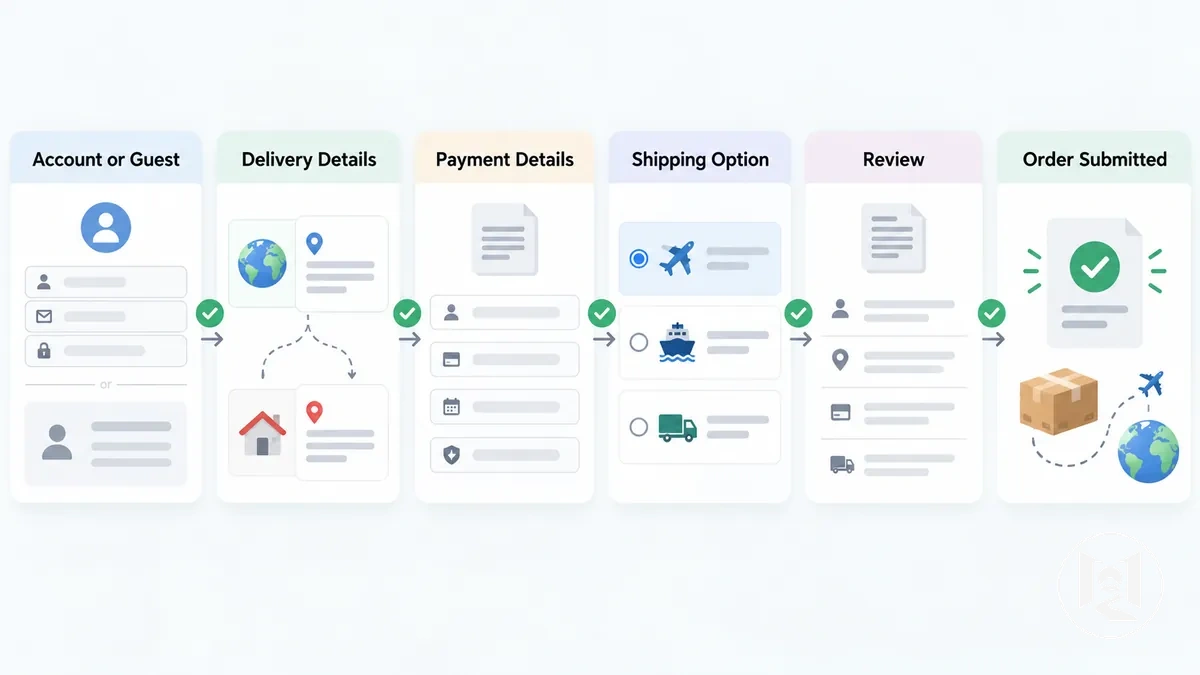
Enter the checkout information required by the retailer for the selected ordering route, including any account or guest details, delivery details, payment details, and available shipping option, then verify the information before submission.
The sequence below represents a generic checkout flow; the exact fields and their order can vary by retailer.
Enter account or guest information: provide the details requested for the available checkout mode and confirm that required fields pass validation before continuing.
Enter delivery details: provide the shipping address appropriate to the selected route and verify whether the checkout expects a supported overseas address or, when required, a Japanese address.
Enter payment details: provide the payment information requested by the retailer and confirm that the selected payment method is accepted for the current checkout.
Select a shipping option: where the retailer presents shipping choices, select an available option for the entered delivery details and verify that the checkout accepts the selection.
Review the order: check the entered account, delivery, payment, and shipping information and resolve any validation errors shown before submission.
Submit the order: use the retailer's final submission action only after the checkout information has passed the required checks, creating a submitted-order state that still requires retailer acceptance.
Retailer field names, validation rules and checkout order can differ. Successful validation means the required inputs passed the current checks; submission creates a submitted-order state that still requires retailer acceptance.
Confirm Payment and Order Acceptance
Payment authorisation, order receipt, and retailer acceptance are separate post-submission states and should be verified independently.
A payment status or automated order confirmation can show that part of the submission was received or processed, but neither state alone proves that the retailer has accepted the order for fulfilment.
Do not treat these states as equivalent
Payment authorisation
Shows the payment state, such as a pending or approved authorisation. It does not prove that the retailer accepted the order.
Order receipt or order number
Shows that the system recorded the submission when that is what the retailer's message states. It is not necessarily a fulfilment commitment.
Retailer acceptance
Use an order status or retailer communication showing that the order was accepted or is progressing toward fulfilment.
Cancellation
A retailer cancellation or cancelled status means the submitted order is not progressing to fulfilment in its current state.
Use retailer acceptance—not a card authorisation, order number or automated receipt—as the evidence that fulfilment is progressing. If the retailer later reports a cancellation, that newer state controls the interpretation.
Complete Any Required Japan-Side Handoff Before International Shipping
A Japan-side handoff applies only when the selected ordering route requires domestic receipt at a Japanese address or processing by an intermediary before overseas shipment.
When that handoff is required, verify the transition from retailer dispatch through Japan-side receipt or processing to readiness for the next shipping stage.
Confirm retailer dispatch: verify that the retailer has dispatched the order to the Japanese address or intermediary required by the selected route.
Confirm Japan-side receipt or processing: use the available receipt or processing confirmation to verify that the parcel reached the next responsible party in Japan.
Confirm readiness for overseas shipment: verify that the receiving party has completed the required handoff state and identifies the parcel as ready for the next overseas-shipping stage.
Direct-shipping orders can skip this stage. For a route that uses a Japanese address or intermediary, treat the handoff as complete only when the available status confirms receipt or processing by the relevant Japan-side party and readiness or responsibility transfer to the next shipping stage.
Confirm the Order Has Entered International Shipping
Confirm entry into international shipping by checking for observable evidence that the shipment has moved beyond the preceding fulfilment stage, such as dispatch confirmation, a shipment reference linked to a carrier, a handoff confirmation, or shipment status showing international movement.
These signals verify a change in fulfilment stage rather than final delivery, and their evidentiary weight can differ.
Dispatch confirmation: treat a retailer or route-specific dispatch confirmation as evidence that the parcel has been released for the next shipping stage, while checking whether the status specifically indicates international dispatch.
Shipment reference: a shipment or tracking reference identifies the shipment with a carrier when available, but creation of the reference alone does not confirm physical carrier movement.
Handoff confirmation: when the selected route generates a handoff confirmation, use it as evidence that responsibility has transferred to the party handling the international shipping stage.
Shipment status: treat a carrier status showing pickup, acceptance, departure, or other physical movement toward the destination as stronger evidence that international shipping has begun than label creation alone.
Label or tracking-reference creation alone is not proof of physical international movement. A carrier status showing pickup, acceptance, departure or other physical movement toward the overseas destination provides stronger evidence that international shipping has actually begun.
When the Overseas Ordering Process Cannot Continue
When an overseas order cannot continue, first identify the failure stage before choosing a corrective direction.
Classify the stopping point as before checkout, during checkout validation, or after order acceptance, then use evidence from that stage to determine which constraint should be checked rather than assuming one visible symptom proves a single cause.
Before checkout: if the order cannot reach checkout, check eligibility evidence such as destination support, store or item restrictions, and whether the selected ordering route is available; the corrective direction is to address the specific eligibility constraint indicated by those checks.
During checkout: if checkout information cannot pass validation or the order cannot be submitted, check the address, payment, shipping-option, and other retailer-required validation results; the corrective direction is to correct only the input or condition identified by the checkout evidence.
After order acceptance: if an accepted order does not advance to the expected handoff or international-shipping stage, check the available order status, handoff confirmation, and other evidence showing whether responsibility moved to the next party; the corrective direction depends on the verified stopping point rather than a presumed cause.
Pre-checkout failures are primarily eligibility problems, checkout failures are validation or submission problems, and post-acceptance failures belong to fulfilment or handoff. Similar symptoms can have different causes, so use evidence from the actual stopping stage and do not expand the diagnosis into customs, tracking or delivery unless the order has reached those later stages.
Store, Item, or Destination Restrictions Prevent the Order
An overseas order can be blocked by a retailer restriction, an item restriction, or a destination restriction, and the restriction source should be identified from observable evidence before choosing a corrective direction.
Similar symptoms can appear at different restriction levels, so check the retailer's shipping availability, the item's eligibility, and the destination-specific result separately rather than inferring the cause from a generic error.
Retailer-level restriction: check whether the retailer's policy or ordering system shows shipping availability for the destination at all; if the store does not serve that destination under the selected route, the corrective direction is to address that retailer-level eligibility constraint rather than treating the item itself as restricted.
Item-level restriction: check the specific product or product-category eligibility for the selected destination; if other items remain eligible while this item does not, the evidence points to an item restriction and the corrective direction should stay focused on that item's eligibility.
Destination-level restriction: check whether the entered country, region, or delivery address is outside the destination availability shown for the order; when the evidence identifies the destination as the limiting condition, the corrective direction is to resolve that destination restriction rather than assuming a store-wide or item-wide restriction.
A generic checkout error does not identify the restriction source. Compare retailer-level availability, item or category eligibility, and the destination-specific result; the corrective action should stay focused on the level that the available evidence actually identifies.
Address or Payment Requirements Block Checkout
If a checkout error prevents the order from continuing, check the address-side and payment-side inputs independently because similar symptoms can result from different validation or acceptance conditions.
Separate address validation and address eligibility from billing details, payment method support, and authorisation status before choosing a corrective direction.
Address — Format: check whether the entered address passes the retailer's address validation rules and whether any displayed error identifies a field or formatting condition that must be corrected.
Address — Eligibility: check whether the delivery address is eligible for the selected destination and ordering route rather than assuming a correctly formatted address is also accepted for delivery.
Address — Route requirement: if the selected route requires a Japanese address, check that the checkout is using the required domestic address context; do not assume a Japanese address is required when the retailer supports the entered overseas address directly.
Payment — Billing details: check whether the billing details satisfy the information requested for the selected payment method and whether the checkout identifies a billing-related validation issue.
Payment — Method acceptance: check whether the selected payment method is available and accepted for the current retailer and checkout context rather than treating every payment option as universally supported.
Payment — Authorisation: if the payment details pass input validation but authorisation does not succeed, treat that as a payment-side state distinct from an address mismatch or address eligibility failure.
A correctly formatted address may still be ineligible for the selected route, and valid billing details do not guarantee payment-method acceptance or authorisation. Use the specific validation message, payment status or other checkout evidence to determine whether the next correction belongs on the address side or the payment side.
The Order Is Accepted but Cannot Proceed to International Shipping
An accepted order can still stop before international shipping if the expected post-acceptance transition has not been confirmed.
Identify whether the missing signal occurs during retailer fulfilment, a required Japan-side handoff, or international-shipping readiness, because the same apparent processing delay can reflect different stages and does not by itself establish a blocked transition.
Retailer fulfilment: if the accepted order has not reached retailer dispatch or another expected fulfilment state, check the retailer's order status or communication for evidence of continued processing, a hold, or another stage-specific constraint; the corrective direction should remain with the retailer-fulfilment stage until a later handoff is confirmed.
Japan-side handoff: when the selected route requires domestic receipt or intermediary processing, check for the expected receipt, processing, or responsibility-transfer signal; a missing signal indicates that the handoff stage has not yet been verified, but does not by itself identify why the transition has not occurred.
International-shipping readiness: if retailer fulfilment and any required Japan-side handoff are confirmed, check for the status or confirmation showing that the parcel is ready for international shipment or has moved to the next responsible party; absence of that expected signal keeps the stopping point at the shipping-readiness stage until further evidence clarifies the constraint.
Keep the stopping point at the earliest unconfirmed stage: retailer fulfilment, a required Japan-side handoff, or international-shipping readiness. A direct-shipping route may skip the Japan-side handoff. Treat the transition as blocked only when an observable status, message or failed expected signal supports that interpretation; an ordinary processing delay alone is not enough.