
Consolidating Multiple Packages from Japan Into One Shipment
Package consolidation combines multiple checked-in parcels at the same Japanese warehouse into one repacked outbound parcel. It can reduce redundant packaging or empty space, but it does not guarantee a lower international shipping charge because the finished parcel is reweighed and remeasured and the billing basis depends on its actual weight, dimensions, volumetric weight and the carrier's applicable rules.
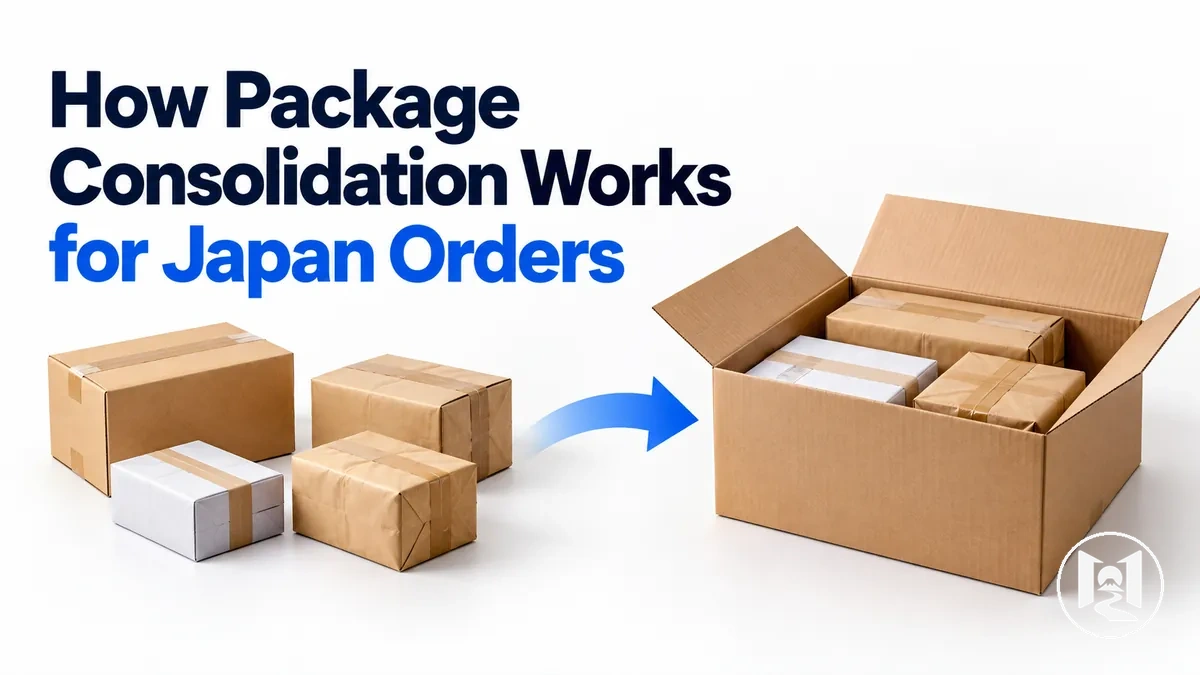
Package consolidation at a glance
Use this four-stage map to decide whether consolidation is suitable, understand what changes at the warehouse, and know what to verify before international dispatch.
- Confirm readinessAll intended parcels should be checked in, within the applicable timing conditions, and compatible with one combined shipment.
- Combine and repackThe warehouse combines the selected contents. Redundant outer packaging may be removed, while protection that remains necessary may be retained or added.
- Reweigh and remeasureThe finished parcel receives new actual-weight and external-dimension measurements. These replace the separate incoming parcel measurements for the consolidated shipment.
- Verify before releaseCheck the included parcel set, package count, final measurements, handling notes or status, and any service-specific release confirmation.
Consolidation is most favourable when the parcels are ready and compatible, the timing is acceptable, and repacking can improve packaging efficiency without creating a worse size, protection, or handling outcome. Fewer parcels alone do not guarantee lower shipping charges.
Package consolidation is the warehouse operation of selecting, combining, repacking and remeasuring parcels; it is not the entire forwarding or proxy-buying workflow. The sections below separate suitability, warehouse process, post-repacking shipping attributes, and final verification so each decision can be checked at the stage where it matters.
Table of Contents
When Package Consolidation Makes Sense for Orders from Japan
Package consolidation is most suitable when several compatible parcels are at the same warehouse and combining them can reduce redundant packaging or repeated shipment overhead without creating a worse size, weight, timing, or handling outcome.
Parcel count alone does not determine suitability; the likely characteristics of the parcel after repacking matter as well.
Parcel readiness, item compatibility, timing, and likely packaging efficiency determine whether a consolidation request makes sense.
Parcels must be eligible to share one shipment, while any wait for pending parcels must remain acceptable under the warehouse's applicable timing conditions.
Repacking can reduce redundant packaging, empty space, or packaging mass, but it can also produce different package dimensions and actual weight.
The image illustrates how parcel compatibility and package shape can change whether consolidation is sensible, while the criteria below separate conditions that favour consolidation from those that can make it less suitable.

- Parcel count and readiness favour consolidation when several intended parcels have reached the same warehouse and are eligible to be included in one consolidation request.
- Item compatibility favours consolidation when the parcels can share one combined package without conflicting handling or packaging requirements.
- Timing favours consolidation when waiting for any remaining parcels is acceptable and the applicable warehouse storage or consolidation window does not conflict with dispatch urgency.
- Packaging efficiency favours consolidation when repacking is likely to remove redundant outer packaging, reduce empty space, or lower packaging mass without creating inefficient package dimensions.
- Bulky or fragile items can make consolidation less suitable when their shape, protection needs, or special handling requirements make the resulting parcel harder to pack efficiently.
- Time-sensitive parcels can make consolidation less suitable when waiting for other purchases would delay dispatch beyond the shopper's acceptable timing.
For example, several small, compatible purchases that arrive as separate warehouse parcels can be a sensible consolidation candidate if they are ready at the same time and can be repacked efficiently.
A bulky parcel combined with fragile items may be less suitable if additional protective packaging increases the final package dimensions or actual weight.
Likewise, waiting for a pending parcel may be inappropriate when dispatch is time-sensitive.
Package consolidation suitability therefore depends on the resulting parcel and its handling and timing conditions, not on parcel count alone.
What to Check Before Requesting Package Consolidation
A consolidation request should be submitted only after the intended parcel set is ready and the warehouse conditions for combining it have been verified.
Check parcel readiness first, including whether the intended parcels are checked in, before treating the set as available for consolidation.
The pre-request checks fall into four planning groups: readiness, timing, item compatibility or handling requirements, and expected remeasurement after repacking.
Timing includes any consolidation window or storage condition set by the warehouse policy, while compatibility covers whether special handling could affect how the parcels are combined.
These checks help prevent a premature request or an unsuitable combination without assuming that every warehouse uses the same deadlines, fees, or packaging rules.
The image organizes these conditions before the checklist and shows that final dimensions and final weight are determined only after repacking.

- Parcel readiness: confirm that the parcels intended for the consolidation request are present in the warehouse system and checked in rather than still pending.
- Timing constraints: verify the applicable consolidation window, storage period, or request-timing condition under the warehouse policy before submitting the request.
- Item compatibility and handling: confirm that fragile, oversized, or special-handling items are eligible to be combined under the warehouse's applicable rules.
- Post-repacking measurements: expect the combined parcel to be remeasured after repacking, because its final dimensions and final weight are based on the resulting package rather than the separate incoming parcels.
Service-specific deadlines, fees, packaging choices, and eligibility conditions should be verified with the relevant warehouse because these policies are not universal.
The final dimensions and final weight become known after the warehouse completes repacking and remeasurement.
Wait Until All Intended Parcels Are Checked In
A consolidation request should normally wait until every intended parcel is shown as received or checked in by the warehouse.
A carrier delivery scan and a warehouse check-in are separate status events, so a parcel marked delivered by the carrier may not yet be available for consolidation.

- Parcel identifier: confirm that each parcel record matches an item intended for the combined shipment.
- Warehouse receipt: verify that each intended parcel is recorded as received or checked in by the warehouse.
- Split shipment: check whether one seller order was dispatched as multiple parcels and whether every part has reached the warehouse.
- Pending delivery: identify any parcel that is still awaiting seller dispatch, carrier delivery, or warehouse intake.
- Set completeness: submit the consolidation request only when the warehouse records show the full intended parcel set as available.
Parcel identifiers help distinguish a complete set from parcels that belong to another order or shipment.
A split shipment can leave one parcel checked in while another remains pending, even when both originated from the same purchase.
Warehouse intake timing can differ by warehouse, so no universal check-in delay should be assumed.
Use the warehouse check-in records as the practical verification point before requesting consolidation.
Check the Consolidation Window and Item Compatibility
Consolidation eligibility depends on two separate checks: confirm that the request is still within the warehouse's applicable consolidation window and confirm that the intended parcels have suitable item compatibility.
Timing eligibility does not by itself mean that every parcel can be combined safely or under the warehouse policy.

- Consolidation window: verify that the request falls within the timing conditions set by the warehouse, including any applicable storage deadline or request window.
- Parcel eligibility: confirm that each parcel may be included in consolidation under the warehouse's current service conditions before treating the set as combinable.
- Fragile items: a fragile item may require protective packaging or special handling that affects whether it is suitable to share one package with other parcels.
- Oversized items: an oversized item may be unsuitable for consolidation when its dimensions or handling needs conflict with the intended combined package.
- Special packaging and warehouse restrictions: verify whether service-specific packaging or handling requirements could prevent particular items from being combined or require a different packing arrangement.
Warehouse policies can set different storage deadlines, consolidation windows, parcel eligibility conditions, and special handling requirements, so fixed limits should not be assumed across services.
Physical compatibility also depends on the characteristics and packaging needs of the items rather than timing alone.
Two parcels may each be individually shippable yet still require different handling when combined.
Both timing eligibility and item compatibility should therefore be confirmed before the parcels are grouped into one shipment.
How Package Consolidation Works at the Warehouse
Warehouse consolidation starts when the warehouse selects the eligible checked-in parcels included in the request and ends with one consolidated parcel that has been reweighed and remeasured.
The selected contents are combined, repacked into one outbound shipment, and recorded with new package dimensions and actual weight.
The sequence below tracks how several inbound parcel records become one measured outbound parcel.
Packaging materials and handling practices can vary by warehouse, but the high-level state change remains selected parcels → combined contents → repacked parcel → final measurements.
Package consolidation is one warehouse stage within package forwarding from Japan rather than the complete forwarding workflow.

- Select eligible parcels: select the checked-in parcels included in the consolidation request so the intended parcel set is defined for the outbound shipment.
- Combine and repack: combine the selected contents and repack them into one outer carton using the warehouse's applicable packaging and handling practices.
- Close the consolidated parcel: complete the repacked parcel so the separate inbound packages become one consolidated parcel ready for measurement.
- Reweigh and remeasure: record the consolidated parcel's actual weight and package dimensions and confirm the resulting outbound shipment record.
Checked-In Parcels Are Selected for Consolidation
A consolidation request selects specific checked-in parcel records before physical repacking begins.
Each selected parcel record represents a parcel to include in the intended shipment, while parcels outside the selected set remain excluded.

Selected Parcels Are Combined and Repacked
During repacking, the contents of the selected parcels are combined into a new outer carton according to the warehouse's permitted handling options.
Repacking trade-off
- Redundant outer cartons or shipping packaging that no longer serves a protective purpose.
- Excess filler or empty space when the contents can be arranged more efficiently.
- Packaging mass when unnecessary material is removed.
- Protective material required for fragile items or other handling needs.
- A stronger or differently sized outer carton when the combined contents require it.
- Package dimensions or mass when extra protection is necessary.
Practical objective: reduce unnecessary packaging without sacrificing protection that remains necessary for the items being consolidated. The final empty space, dimensions and actual weight depend on the finished packing configuration.
The Consolidated Parcel Is Reweighed and Remeasured
Once repacking is complete, the consolidated parcel is reweighed and remeasured before international dispatch.
- Actual weight
- The finished parcel's scale weight after packaging has been removed, retained, rearranged or added. It may be lower, similar, or higher than the sum of the incoming parcel weights because the packaging configuration has changed.
- External dimensions
- The consolidated parcel's final length, width and height. They can increase when the contents require a larger outer carton or additional protection.
- Shipping basis
- The post-repacking measurements become the relevant shipment data because the original parcel measurements no longer describe the new combined parcel. Any later dimensional- or chargeable-weight calculation depends on the applicable carrier or service rule.
Final measurements are updated values, not a promise of reduction: actual weight and external dimensions can move in different directions after consolidation.
How Consolidation Changes Package Dimensions and Shipping Weight
Repacking creates a new set of shipping attributes for the consolidated parcel.
Its actual weight and external dimensions are measured after consolidation, while volumetric weight and chargeable weight may then be derived from those measurements under the applicable carrier rule.
Actual weight is the parcel mass measured on a scale, while external dimensions describe its length, width, and height after repacking.
Volumetric weight, also called dimensional weight, is a calculated value based on package volume and a carrier-specific formula rather than a direct measurement.
Chargeable weight is the billing basis selected under the relevant service rules, which may use actual weight, volumetric weight, or another defined comparison method.
The table separates these measured attributes from carrier-derived values and shows what each post-consolidation change can affect.
| Shipment attribute | What changes after consolidation | What it can affect |
|---|---|---|
| Actual weight | The consolidated parcel receives a new measured actual weight after repacking; packaging mass may decrease or increase depending on what is removed, retained, or added. | The measured mass can affect the later shipping calculation where the carrier rule uses actual weight. |
| External dimensions | The final length, width, and height reflect the new outer parcel rather than the separate original boxes. | The new dimensions can affect package-volume calculations, size limits, and carrier-derived dimensional measures. |
| Volumetric/dimensional weight | Volumetric weight or dimensional weight is calculated from the consolidated parcel's external dimensions using the applicable carrier formula. | It can affect the billing basis when the carrier rule compares dimensional weight with another weight measure. |
| Chargeable weight | Chargeable weight is determined from the post-repacking shipment data according to the applicable carrier or service rule. | It can affect the weight basis used for shipping charges, but fewer parcels do not by themselves guarantee a lower charge. |
The physical measurements and carrier-derived values can therefore move in different directions after consolidation; reducing packaging mass does not necessarily reduce external dimensions, volumetric weight, or chargeable weight.
The final shipping implication depends on the post-repacking measurements and the specific carrier rule applied to them.
A broader total-order-cost calculation belongs outside this attribute comparison because shipping weight is only one part of the overall cost picture.
How Repacking Changes Actual Weight
Actual weight after repacking can decrease, stay similar, or increase depending on the packaging material that is removed, retained, or added.
What changes the scale weight
When the warehouse removes more packaging mass than it adds, such as a redundant outer carton or excess filler.
When the mass removed and the replacement or retained packaging are broadly similar.
When added protection, a stronger carton, or other required packaging adds more mass than repacking removes.
The final scale weight is the combined contents plus the packaging that remains around them after repacking. Only the post-repacking weighing establishes the consolidated parcel's final actual weight.
How Package Dimensions Affect Volumetric and Chargeable Weight
A consolidated parcel's length, width and height determine its package volume, which can be used to calculate volumetric weight, also called dimensional weight.
From dimensions to the billing basis
A physically lighter parcel can still have a higher calculated dimensional weight when its external dimensions create more package volume.
Repacking improves dimensional efficiency only when it reduces the relevant box volume under the applicable calculation method. If length, width or height remains large because the contents or protective packaging require a larger carton, volumetric weight may remain similar or increase even when actual weight decreases.
The effect on chargeable weight therefore depends on both the post-repacking dimensions and the carrier-specific treatment of actual and dimensional weight.
What to Verify After Consolidation Before International Dispatch
Before international dispatch, verify that the final consolidated shipment matches the intended parcel set and that its recorded shipment state is acceptable for release.
Confirm the available parcel records and final shipment details before authorizing dispatch rather than assuming consolidation alone proves completeness.
The final checks should cover both content or record completeness and the post-repacking shipment attributes that now describe the outbound parcel.
Compare the included parcels with the intended parcel set, confirm any recorded handling request or packaging choice, and review the final package count, actual weight, final dimensions, warehouse note or status, and any service-specific release confirmation that the warehouse provides.
These checks establish whether the available records and measurements match the expected finished shipment state.
If a material mismatch appears, such as an unexpected package count, missing parcel record, or unexplained weight difference, pause the release and seek clarification before international dispatch.
- Included parcels: verify that the available parcel records match the intended parcel set and that no intended parcel appears omitted or unintended parcel appears included.
- Handling request: confirm any recorded handling request or packaging choice where the warehouse provides that information.
- Final package count: compare the recorded package count with the expected consolidated shipment state.
- Actual weight: review the recorded post-repacking actual weight and check whether an unexpected result requires clarification.
- Final dimensions: verify the recorded length, width, and height or other available final dimensions for the consolidated parcel.
- Warehouse note or status: review any warehouse note, exception, or visible status that could affect release for international dispatch.
- Release confirmation: complete any service-specific confirmation required before the consolidated shipment is released for international dispatch.
Common Package Consolidation Risks and Mistakes
Package consolidation mistakes are avoidable process risks rather than guaranteed failures.
Problems can arise when a consolidation request is made too early, the intended parcel set is incomplete, unsuitable items are combined, packaging removal is misunderstood, or the finished parcel is not verified before release.
The main error classes are premature consolidation, an omitted or unchecked-in parcel, poor item compatibility involving a fragile item or special handling need, incorrect assumptions about packaging removal, unexpected dimensions or unexpected weight after repacking, and skipped final verification.
The table links each mistake to a possible consequence, an observable recognition cue, and a corrective action within the consolidation stage.
| Mistake | Possible consequence | Recognition cue | Corrective direction |
|---|---|---|---|
| Premature consolidation | A request made while an intended parcel is still pending may produce an incomplete consolidated set. | An expected parcel has not yet reached checked-in status when the consolidation request is prepared. | Pause the request until the intended parcel set is complete or deliberately revise which parcels are meant to be included. |
| Omitted or unchecked-in parcel | An omitted parcel may remain outside the finished consolidated shipment if its parcel record was not available or selected. | The intended set and the available warehouse parcel records do not match. | Compare parcel identifiers and checked-in records, then correct the selected set before physical consolidation where the warehouse process allows. |
| Incompatible or fragile combination | Poor item compatibility may require additional protection, a different packing arrangement, or separation rather than one combined parcel. | A fragile item, oversized item, or special handling requirement conflicts with the proposed combined packaging. | Confirm the applicable handling requirements and revise the consolidation arrangement when the items should not share the same packaging configuration. |
| Misunderstood packaging removal | Assuming all packaging can be removed may reduce necessary protection or produce a different result from the requested handling. | The consolidation request treats redundant packaging and protective material as though they serve the same function. | Distinguish packaging that is redundant from material still needed for protection and clarify the permitted handling request before repacking. |
| Unexpected final dimensions or weight | Repacking may result in unexpected dimensions or unexpected weight when packaging is removed, retained, rearranged, or added. | The recorded final measurements differ materially from the expected post-repacking parcel state. | Review the recorded dimensions, actual weight, packaging notes, and relevant handling information before release, and seek clarification where the difference is unexplained. |
| Skipped final verification | A mismatch in parcel records, measurements, handling notes, or package count may go unnoticed before dispatch. | The consolidated shipment is ready for release without a final comparison against the intended parcel set and recorded shipment state. | Complete final verification and pause release when a material mismatch requires clarification. |
The consequence of any consolidation error depends on the parcels, packaging requirements, warehouse records, and handling conditions involved; a process risk does not mean the same outcome will occur in every case.
Prevention therefore depends on checking the intended set, compatibility, handling assumptions, final measurements, and shipment record at the relevant consolidation stage, then taking corrective action before dispatch when a meaningful mismatch appears.