
How Package Forwarding Works for Japanese Online Shopping
Package forwarding routes a Japanese online order through a service-issued Japanese address: the store sends the parcel domestically to the forwarder’s warehouse, the warehouse matches it to the shopper’s account, and the forwarding service hands it to an international carrier after the shopper submits forwarding instructions. International dispatch proceeds only when the parcel can be identified, the item and route are eligible, and a compatible shipping method is available for the destination.
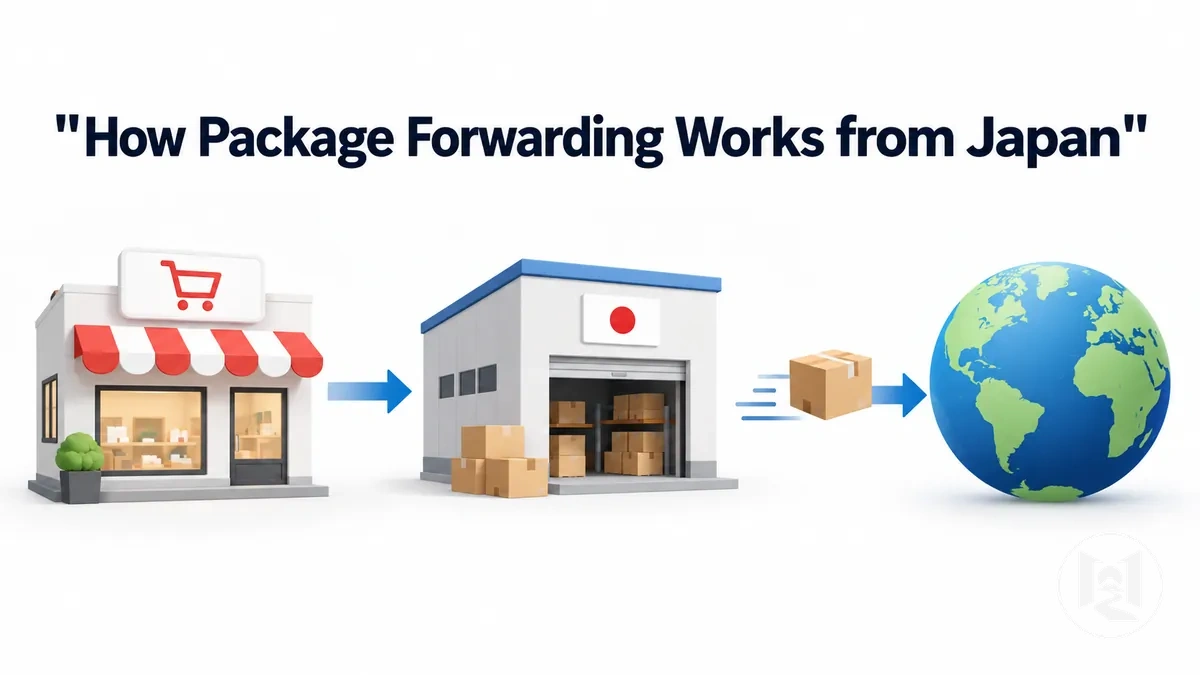
Package forwarding at a glance
The service bridges a domestic Japanese delivery and a separate international shipment. Each handoff changes who is responsible for the parcel.
- 1Get the assigned addressThe forwarding service supplies the Japanese delivery address and any account identifier needed for parcel matching.
- 2Place the store orderThe shopper enters those assigned details, and the Japanese store sends the order by domestic delivery to the forwarding warehouse.
- 3Match the parcelThe warehouse receives the parcel and associates it with the correct forwarding account before further instructions can be acted on.
- 4Forward internationallyThe shopper selects an eligible method and submits the required instructions; the forwarder then arranges handoff to the international carrier.
Before international dispatch
- Account match
- The warehouse must be able to identify the parcel to the correct account.
- Parcel eligibility
- The item and parcel must satisfy the forwarder and selected shipping method’s applicable conditions.
- Route availability
- An eligible shipping method must be available for the destination and route.
Key distinction: package forwarding covers the address, receipt, identification, and reshipping handoff. It does not automatically place the store order or override merchant, carrier, or destination-country rules.
The sections below explain each handoff, the identification details that keep a parcel tied to the correct account, and the limits that can prevent onward shipment.
Table of Contents
What Package Forwarding Does in a Japanese Online Order
Package forwarding provides the domestic-address and reshipping layer between a Japanese online store and an overseas shopper. The service receives the store’s domestic delivery, identifies the parcel to the shopper’s account, and arranges onward international dispatch when an eligible route is available.
- Shopper
- Places the store order, uses the assigned forwarding details, and later submits the required forwarding instructions.
- Japanese store
- Sends the purchased parcel by domestic delivery to the assigned forwarding warehouse.
- Forwarding service
- Receives the parcel, associates it with the correct account, and arranges onward shipment using an eligible method.
- International carrier
- Transports the dispatched parcel on the selected international route after the forwarder hands it over.

Package forwarding does not necessarily include purchasing. The shopper normally remains responsible for placing the store order unless the provider separately offers a purchasing function.
Its core scope is the Japanese address → warehouse receipt → account identification → international reshipment handoff; it does not by itself satisfy every merchant-checkout, carrier, customs, or import requirement.
Package Forwarding for Online Orders vs Luggage and Mail Forwarding
Package forwarding for an online order, luggage forwarding, and mail forwarding are different service contexts despite sharing the word “forwarding”. Online-order package forwarding concerns a purchased parcel sent from a Japanese store to a forwarding warehouse for international reshipment, while luggage forwarding concerns a traveller’s baggage and mail forwarding concerns redirected correspondence.

The relevant differences are what is forwarded, the typical sender or origin, and the primary delivery purpose.
Keeping those dimensions separate prevents luggage-forwarding or mail-forwarding rules from being applied to package forwarding for an online order.
| Service context | What is forwarded | Typical origin or sender | Primary delivery purpose |
|---|---|---|---|
| Online-order package forwarding | Purchased parcel | Japanese online store sending a domestic delivery to a forwarding warehouse | Receive the parcel at a Japanese warehouse and arrange international reshipment to the shopper's destination |
| Luggage forwarding | Personal luggage or baggage | Traveller or travel accommodation within a travel itinerary | Move baggage between travel locations through domestic delivery where that service is available |
| Mail forwarding | Letters and other correspondence | Mail addressed to one location under a forwarding arrangement | Redirect correspondence to another delivery address |
The Package Forwarding Process from a Japanese Store to International Dispatch
The package forwarding process moves from an assigned Japanese address to the shopper's store order, domestic delivery to the forwarding warehouse, parcel identification, and finally international dispatch.
Responsibility shifts from the shopper to the Japanese store, then to the forwarding warehouse and onward carrier as the parcel moves through those handoffs.

The four stages below show the responsible party, the action at each handoff, and the resulting parcel state without treating provider-specific processing as universal.
- Receive the assigned Japanese address: The forwarding service provides the shopper with an assigned Japanese address for the forwarding account, creating the domestic destination used for the store order.
- Place the store order: The shopper enters the assigned Japanese address when ordering from the Japanese store, and the store sends the parcel by domestic delivery to the forwarding warehouse.
- Receive and identify the parcel: The forwarding warehouse receives the shipment and performs parcel identification so it can be associated with the shopper's account; inspection or notification procedures may differ by service.
- Give forwarding instructions and dispatch internationally: The shopper provides the required forwarding instructions and selects an available shipping method for the destination, after which the forwarding service arranges international dispatch and hands the parcel to the onward carrier.
Register and Receive a Japanese Forwarding Address
Register for a forwarding account and obtain the exact service-issued Japanese forwarding address before placing a store order. Those account details create the domestic delivery destination and the identifiers the warehouse may use to match a later parcel.

- Japanese address
- Use the address supplied by the forwarding service rather than a generic warehouse address or self-created format.
- Recipient or account name
- Copy the name exactly when the provider uses a specific recipient or account-name format for incoming parcels.
- Member or account ID
- Include the identifier wherever the provider requires it so the warehouse can associate the delivery with the correct account.
- Registration conditions
- A provider may require additional account information or identity verification before the forwarding account can be used.
Before checkout, follow the provider’s current instructions exactly. The required wording and field placement are service-specific, so there is no single universal forwarding-address format to substitute for the details you were assigned.
Place the Store Order Using the Forwarding Address
Enter the service-issued forwarding address as the shipping address at the Japanese store and reproduce the assigned details exactly so the parcel is routed to the intended warehouse.

Warehouse Receipt, Parcel Identification, and Processing
When a parcel reaches the forwarding warehouse, warehouse processing begins with parcel receipt and parcel identification so the received parcel can be associated with the correct forwarding account.
The warehouse then records the matched parcel or provides a status update according to its process, creating the account state needed before the shopper gives a forwarding instruction.

The warehouse sequence separates receipt, account matching, status recording, and readiness for the next action.
Identification data can vary by provider, but may include the parcel label, account identifier, merchant information, or tracking information.
- Receive the parcel: The forwarding warehouse accepts the domestic delivery and records parcel receipt as the start of warehouse intake.
- Match the parcel to an account: The warehouse uses the available parcel label and account identifier, and may also use merchant or tracking information, to perform account matching. If the parcel cannot be matched confidently, it cannot reliably move to the identified-account state until the necessary information is resolved.
- Record the warehouse status: After parcel identification, the service records the received parcel against the forwarding account and may provide a status update showing that the parcel has been received or processed for the next action.
- Make the parcel ready for instructions: Once the parcel is associated with the correct account and its warehouse status is recorded, it reaches the ready state for the shopper's next forwarding instruction.
Select International Shipping and Submit Forwarding Instructions
A received parcel can move toward international dispatch only after the shopper selects an international shipping method that is available for the destination and compatible with the parcel.
Availability can depend on the provider, route, carrier option, and parcel eligibility, so a method that is unavailable for a particular destination or item cannot be used for that onward shipment.
The forwarding instructions should complete the post-receipt decisions needed to make the parcel dispatch-ready: confirm an available route, provide the required shipment information, review applicable charges, and submit the dispatch instruction.
- Check shipping-method availability: Select from the international shipping options offered for the destination and route. Available carrier options can differ according to the forwarding provider and destination.
- Confirm parcel eligibility and shipment information: Verify that the parcel is eligible for the selected shipping method and provide any shipment information required by the provider for that route or item category.
- Review applicable charges: Confirm the charges presented for the selected shipping method and parcel conditions before submitting the forwarding instruction; the applicable amount depends on the provider, route, parcel, and selected service.
- Submit the forwarding instruction: Confirm the selected shipping method and required details so the forwarding service can move the parcel into international dispatch.
If a shipping method is unavailable because of the destination, parcel eligibility, item restrictions, or route conditions, another eligible option must be available and selected before dispatch can proceed.
Charges remain one input to that decision, while the section ends when the required forwarding instructions have been accepted for international dispatch.
Forwarding Address and Parcel Identification Requirements
Successful warehouse receipt depends on the forwarding warehouse being able to associate an incoming parcel with the correct forwarding account.
The main criteria fall into two groups: address-identity data that directs and identifies the account, and parcel-matching data that helps connect the received parcel with the shopper's order.
The required details vary by provider, but each criterion affects whether parcel identification can be completed confidently.
- Assigned address: The parcel should use the service-issued assigned address according to the provider's instructions. Missing or materially altered address details can interfere with delivery to the intended warehouse or with identifying the intended forwarding account.
- Recipient name: When a provider uses a particular recipient name as part of account identification, that name should be entered as instructed. An inconsistent name can reduce the information available for parcel matching even when the warehouse address itself is correct.
- Member identifier: If the service assigns a member identifier or account identifier for incoming parcels, it should appear where the provider requires it. Omitting or changing an identifier used for account matching can delay or prevent association with the correct forwarding account.
- Order information and tracking information: A provider may use an order reference, merchant information, tracking information, or details on the parcel label to support parcel identification. When these details are available and consistent with the account record, they provide additional evidence for matching the received parcel to the correct customer.
A provider-specific formatting preference is not necessarily the same as an account-identification requirement; the decisive condition is whether the information the service actually uses for identification is present and consistent.
Missing or inconsistent identification data can therefore delay warehouse processing or prevent reliable parcel identification until the forwarding account and received parcel can be matched.
Name, Japanese Address Format, and Account Identifier Requirements
Copy the service-issued recipient name, Japanese address, and account identifier according to the provider's current instructions rather than applying a universal address format.
These assigned details serve two functions: the postal address identifies the physical forwarding destination, while the recipient name or member ID can help identify the correct forwarding account when the provider uses those details for matching.
- Recipient name: Reproduce the recipient name as supplied and place it according to the relevant provider instruction. If the service uses that name for account identification, changing or omitting it can reduce the information available for matching the parcel to the forwarding account.
- Japanese postal address: Copy the assigned Japanese address, including the supplied postal code and other postal address components, without imposing a different address order or field syntax. Merchant address fields can vary, but the destination data should remain consistent with the forwarding address issued by the provider.
- Account identifier or member ID: When the provider assigns an account identifier, member ID, or customer identifier for incoming parcels, reproduce it where the provider instructs. Placement can depend on the forwarding service or merchant form, so the identifier should not be reformatted according to an assumed universal rule.
- Conditional supporting fields: A building detail, phone number, or other assigned field may be required by a particular provider or checkout form. Use these details when the provider instruction requires them, without treating any one supporting field as mandatory for every forwarding service.
Field placement, name formatting, and romanization can vary by provider or merchant form, so check the forwarder's current account instructions rather than relying on a general Japanese address template.
Exact reuse of the service-issued recipient name, Japanese address, account identifier, and any conditionally required supporting details gives the warehouse the information intended for reliable account identification.
Order Details That Must Match the Forwarding Account
Only the order or parcel details that the forwarding service actually uses for parcel matching need to correspond with the forwarding account.
Check the relevant recipient identity, member identifier, order reference, tracking information, or pre-registration data according to the provider's current requirements rather than assuming that general checkout or payment details must match.
- Verify recipient identity and member identifier: If the service uses the recipient identity, member identifier, or another account identifier to associate incoming parcels with a forwarding account, confirm that the information supplied with the order matches the account details the provider expects. An inconsistent identifier can delay or prevent reliable account matching.
- Verify the merchant or order reference: When the forwarding service uses merchant information, an order reference, or another order identifier for parcel matching, confirm that the recorded information corresponds with the incoming parcel. A missing or inconsistent reference can reduce the information available for identification.
- Verify domestic tracking information: If domestic tracking information or a tracking number is used to identify an expected parcel, check that it is associated with the correct forwarding account or order record. Incorrect tracking information can result in delayed identification until the parcel can be matched through other supported details.
- Verify any required pre-registration: Some providers may require an expected parcel, merchant, order reference, or tracking number to be registered before or around warehouse receipt. Where pre-registration is a provider requirement, missing or inconsistent data can leave the incoming shipment without the account information needed for prompt parcel matching.
The verification rule is limited to identifiers the service actually uses to associate the parcel with the forwarding account; it does not make billing address, payment card details, or purchaser name universal forwarding requirements.
When relevant matching data is missing or inconsistent, the practical consequence is delayed or failed parcel identification rather than an automatic assumption that the parcel is lost or rejected.
Restricted Items and Service Limits in Package Forwarding
Package forwarding limits can originate from the forwarder's warehouse acceptance policy, restrictions attached to an international shipping method or carrier, rules for the destination country, or provider-specific handling and storage conditions.
Each rule source affects a different stage of international forwarding, so a restricted item may be unsuitable for warehouse receipt, ineligible for a particular onward route, or subject to a separate service limit after receipt.
The categories below separate the source of each forwarding restriction from the condition it governs and the operational consequence.
- Warehouse acceptance policy: A forwarder's own policy determines which items it is willing or able to accept at its forwarding warehouse. If an item falls outside that warehouse acceptance policy, the restriction affects intake and the parcel may not be eligible for normal warehouse receipt even if another carrier or destination country would otherwise allow shipment.
- Shipping method or carrier restriction: A carrier or shipping method can impose its own parcel eligibility conditions for international forwarding. If the parcel does not satisfy the selected method's item, route, size, handling, or other applicable conditions, that method cannot be used and another eligible shipping method must be selected if one is available.
- Destination-country condition: The destination country can impose import or item-eligibility rules that are separate from the forwarder's commercial service policy. When a destination condition prevents the item from being sent on the intended route, the consequence affects onward shipping to that destination rather than the warehouse's general ability to receive every parcel.
- Warehouse handling or storage condition: A provider may set handling condition or storage condition limits for parcels already received, including service-specific requirements for how certain parcels can be stored or processed. If those conditions are not met, the consequence affects warehouse handling or continued storage according to that provider's policy rather than creating a universal shipping prohibition.
The rule source therefore determines which stage is affected: provider acceptance policy governs intake, carrier or shipping-method rules govern onward shipment options, destination-country rules govern route eligibility, and warehouse handling or storage conditions govern what the service can do with a received parcel.
These categories should be checked separately because a commercial service limit is not the same as a carrier or destination-country restriction.
Items a Forwarding Warehouse May Not Accept
A forwarding warehouse may refuse or conditionally accept a parcel under its own warehouse intake policy before later international-shipping eligibility is considered.
Item acceptance can depend on an item characteristic, parcel characteristic, or service policy, so a restricted item at the intake stage may require refusal, return, special handling, or clarification under the provider's rules.
- Item characteristic: If an item's characteristics fall outside the forwarding warehouse's current item-acceptance rules, the acceptance state may be refusal or conditional acceptance. The warehouse consequence can include return, special handling, or a request for clarification where the service policy provides for those outcomes.
- Parcel characteristic: A parcel characteristic covered by the provider's intake rules can affect whether the warehouse can receive or process the shipment normally. If the parcel does not satisfy the applicable intake condition, the provider may refuse receipt, require clarification, or apply a service-specific handling condition.
- Service-policy restriction: A provider may designate particular item or parcel categories as outside its warehouse service policy or subject to additional conditions. Where that rule applies, item acceptance is determined by the provider's intake policy, and the operational consequence may be refusal, return, or conditional processing.
- Special-handling condition: When the forwarding warehouse accepts an item only under a supported special handling condition, acceptance depends on whether that condition can be met under the provider's current rules. If it cannot, the parcel may require clarification or another intake-stage disposition specified by the service.
Warehouse refusal is a service-policy outcome and does not by itself establish that an item is legally prohibited.
A parcel that satisfies warehouse intake rules can still face separate international-forwarding restrictions later, so warehouse acceptance and onward-shipping eligibility are separate decisions.
Items That May Be Received but Cannot Be Forwarded Internationally
Warehouse receipt does not guarantee international forwarding eligibility. The onward-shipping stage can apply separate carrier, route, regulatory, destination, and shipment-information requirements.
A parcel may therefore be accepted by the warehouse but remain ineligible for international dispatch under the shipping method, item condition, destination-country condition, or current rule set that applies later.
The table separates the main restriction sources from the conditions that trigger them and the practical consequence for parcel eligibility.
Receipt into the warehouse and eligibility for international dispatch are separate states, so each restriction must be evaluated at the onward-shipping stage.
| Restriction source | Triggering condition | Forwarding consequence |
|---|---|---|
| Carrier restriction or shipping method rule | The parcel does not meet the selected carrier or shipping method requirements for the route, service level, item characteristics, or parcel condition. | That carrier option or shipping method cannot be used for the onward shipment unless another eligible method is available. |
| Export control | The item or shipment falls under an export-control condition that applies to its composition, category, destination, or current regulation. | International forwarding cannot proceed under the affected export condition unless the applicable requirement can be satisfied. |
| Destination-country condition | The destination country applies an import or eligibility condition that prevents the parcel from being sent on the intended route. | The parcel is not eligible for dispatch to that destination under the affected condition, even though warehouse receipt has already occurred. |
| Missing required shipment information | Information required for the selected route or shipping method is missing, incomplete, or cannot be confirmed. | Dispatch is delayed or cannot proceed until the required shipment information is supplied or resolved according to the provider's process. |
Storage Periods and Warehouse Handling Limits
Storage time is provider-specific: there is no single forwarding-warehouse storage period that can be assumed for every service. The current service terms determine the parcel’s deadline, available handling, and when the shopper must submit a forwarding instruction.
Current storage window
Check the provider’s stated storage period for the received parcel and treat that deadline as the action window for submitting forwarding instructions.
Extension
Assume an extension only when the provider explicitly offers one and follow any stated eligibility, timing, or fee conditions.
After the stated period
Fees, liability limits, handling restrictions, or another warehouse consequence apply only when the provider’s terms specify them; check the stated consequence before the deadline expires.
Practical rule: submit the forwarding instruction within the provider’s current storage window and account for any documented extension or handling limit before the parcel reaches a restricted storage state. Consolidation is a separate warehouse process and does not remove the need to follow the service’s storage timing.